




Blog
How to Choose Audio Film Capacitors for Hi-Fi Audio and Speaker Crossovers
Audio Capacitor Selection Guide · Hi-Fi Amplifiers · Speaker Crossovers
How to Choose Audio Film Capacitors for Hi-Fi Audio and Speaker Crossovers
Choosing the right audio film capacitor
starts with the circuit’s electrical requirements—not simply
a product’s audiophile label. For Hi-Fi amplifiers, passive
speaker crossovers and audio signal paths, engineers should
compare capacitance, voltage rating, tolerance,
dissipation factor, ESR and available mounting space.
This guide explains those factors and introduces the JFX,
JSX, JPX, JLX and JGX axial audio capacitor series from
jb Capacitors.
What matters most when selecting audio film capacitors?
-
Capacitance (µF):
Match the required filter response or coupling cutoff frequency. -
Voltage rating (VDC):
Allow an appropriate margin above the highest expected
operating voltage and transients. -
Capacitance tolerance:
Consider how component variation affects crossover
frequency and channel matching. -
Loss characteristics:
Review dissipation factor and ESR at relevant frequencies,
especially in high-current circuits. -
Mechanical fit:
Confirm the axial body dimensions, lead diameter,
clearance and mounting method.
Why Use Film Capacitors in Hi-Fi Audio Circuits?
Audio film capacitors use a plastic-film
dielectric—commonly polypropylene in premium audio
series—and are typically non-polarized. Their stable
capacitance, low dielectric losses and suitability for AC
signal paths make them useful in speaker crossover networks,
amplifier signal coupling and selected filter stages.
Actual circuit performance still depends on the capacitor’s
specifications, circuit topology, operating conditions
and component layout.
Audio film capacitors vs. electrolytic capacitors
Film capacitors are often selected for signal-path and
crossover positions where capacitance stability and low
loss matter. Electrolytic capacitors can provide larger
capacitance in a smaller volume or at a lower cost, and
non-polar electrolytic types are also used in speaker
crossovers. The correct choice depends on electrical
requirements, space and budget; neither technology is
automatically superior in every audio circuit.
Five Steps to Choose the Right Audio Film Capacitor
1. Determine the Capacitance
In a passive crossover, capacitance works with the
driver’s impedance and other network elements to shape
frequency response. Follow the crossover schematic or
simulate the complete network rather than choosing by
capacitor size alone.
2. Check Operating Voltage
For amplifiers, assess DC bias, AC swing, startup
conditions and possible transients. For speaker
crossovers, consider peak amplifier output voltage.
Never exceed the applicable capacitor rating.
3. Review Tolerance and Losses
A tighter capacitance tolerance can help maintain a
target crossover response. Compare dissipation factor
and ESR using the datasheet’s stated test conditions;
values measured at different frequencies are not
directly equivalent.
4. Confirm Size and Installation
Axial film capacitors can be physically large at higher
capacitance and voltage ratings. Check enclosure
clearance, lead strain, vibration support and proximity
to heat-producing components.
5. Validate in the Actual Audio Circuit
Confirm the final design using circuit simulation and
electrical measurements. For crossovers, examine impedance
and frequency response; for amplifier stages, check DC bias,
signal swing, distortion and thermal conditions.
Listening evaluations can supplement—but should not
replace—these checks.
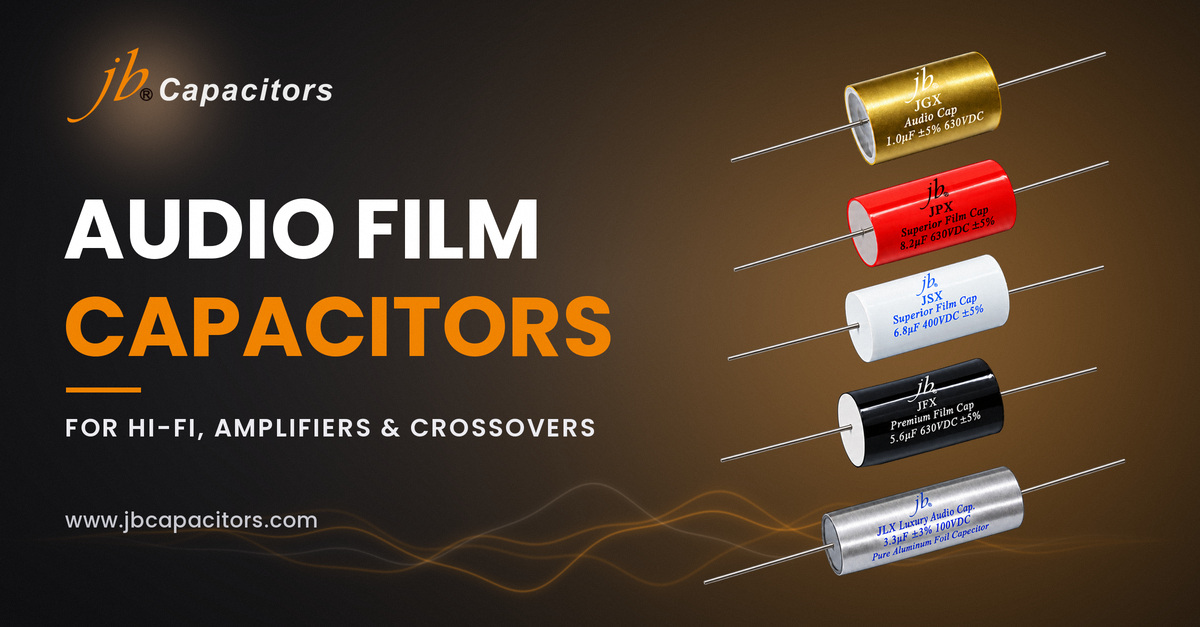
Compare jb Audio Film Capacitor Series
jb Capacitors offers several axial audio film capacitor
families. The table below summarizes their
construction and practical selection focus
rather than claiming that a particular series guarantees
a specific perceived sound character.
| Series | Construction | Selection Focus | Product |
|---|---|---|---|
| JFX Premium | Axial metallized polypropylene film |
General Hi-Fi applications, amplifier circuits and crossover projects |
JFX Details |
| JSX Superior | Axial metallized polypropylene film |
Audio designs requiring close review of tolerance and dielectric-loss specifications |
JSX Details |
| JPX Supreme | Axial metallized polypropylene film |
Higher-specification film option for demanding audio filter and coupling designs |
JPX Details |
| JLX Luxury |
Aluminum foil and metallized polypropylene film, axial |
Premium tweeter and mid-range crossover projects where foil-film construction is desired |
JLX Details |
| JGX Gold |
Gold/copper tube and metallized polypropylene film, axial |
Specialized high-end audio projects requiring this construction and mechanical format |
JGX Details |
Series capabilities and available part numbers differ.
Confirm capacitance, voltage, tolerance, dimensions and
current availability against the latest official product
datasheet before specifying a component.
Where Are Audio Film Capacitors Used?
Passive Speaker Crossovers
Use capacitors in high-pass, band-pass and
impedance-shaping networks. Accurate component
values help maintain the intended crossover
transfer function.
Hi-Fi Amplifier Signal Coupling
Use appropriately rated film capacitors to block
DC while passing the intended audio-band signal
between circuit stages.
Tweeter & Mid-range Filters
Select capacitance and tolerance according to the
driver/network design. Verify voltage stress and
heating under expected listening and test conditions.
Audio Equipment Restoration
Replace aging or unsuitable parts only after
confirming original circuit function, capacitance,
polarity requirements, voltage rating and physical fit.
Watch the jb Capacitors Product Video
Watch the supplied jb Capacitors video below.
For the latest audio film capacitor specifications,
consult the linked product series pages.
Frequently Asked Questions About Audio Film Capacitors
1. What is the best capacitor type for a Hi-Fi speaker crossover?
Metallized polypropylene film capacitors are a common
choice for signal-path positions in passive speaker
crossovers because they offer low dielectric loss and
stable capacitance. However, the best part depends on
the required value, voltage, tolerance, available space
and system budget.
2. How do I choose capacitance for a speaker crossover?
Start with the designed crossover schematic and target
frequency response. A simplified first-order RC model
has a cutoff frequency of approximately
f = 1 / (2πRC), but real loudspeaker
impedance varies with frequency, so a complete crossover
should be modeled and measured with the actual drivers.
3. Does a lower ESR always mean better audio quality?
No. ESR contributes to losses and may matter in certain
circuits, but perceived audio quality cannot be
predicted from ESR alone. Also consider capacitance
accuracy, dissipation factor, voltage stress, circuit
layout and measured system response.
4. Can audio film capacitors be used in amplifier coupling circuits?
Yes, provided the selected capacitor meets the circuit’s
required capacitance, DC voltage and signal conditions.
Its value and the surrounding circuit resistance determine
the low-frequency response; physical fit and reliability
must also be checked.
5. What is the difference between JFX, JSX, JPX, JLX and JGX?
JFX, JSX and JPX are axial metallized polypropylene
audio film capacitor series with different published
loss specifications. JLX uses an aluminum foil and
film construction, while JGX uses a gold/copper tube
and film construction. Select among them by verified
electrical ratings, component dimensions and
application requirements—not series names alone.
Find the Right jb Audio Film Capacitor for Your Project
Whether you are designing a high-fidelity amplifier,
specifying a speaker crossover or sourcing axial audio
capacitors for production, jb Capacitors can help you
compare suitable series.
For an efficient technical review, share the
required capacitance, voltage, tolerance,
available dimensions, estimated order quantity and
application details with your inquiry.