





Blog
jb TOP 5 Electronic Components: Reliable Circuit Solutions
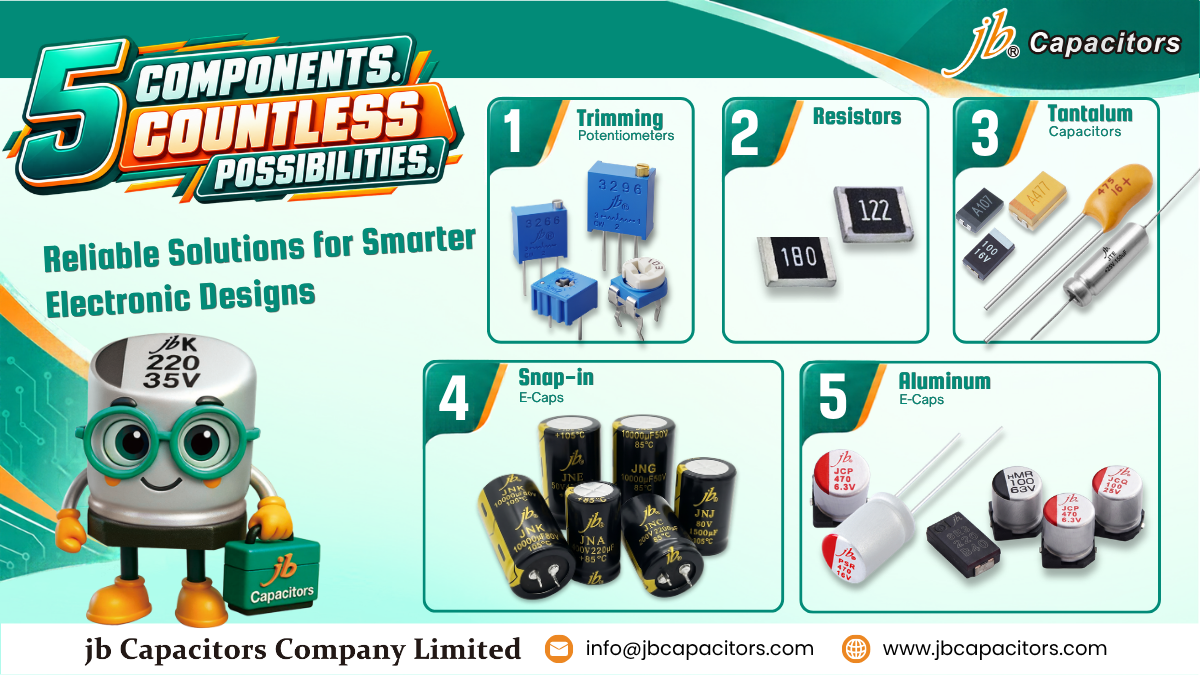
Countless Possibilities.
Every reliable electronic system begins with selecting the right components. Whether developing industrial automation equipment, compact consumer electronics, telecommunications hardware, or power conversion systems, component selection directly influences circuit stability, efficiency, thermal performance, and long-term reliability.
As an electronic components supplier, jb Capacitors provides a broad portfolio of passive component solutions for engineers, purchasing professionals, OEM manufacturers, and electronics designers.
Our featured TOP 5 Electronic Components bring together precision adjustment, resistance control, compact capacitance, bulk energy storage, and low-impedance power filtering. Each product family serves a different engineering function, helping designers identify suitable component technologies across diverse applications.
Explore the key characteristics, practical applications, and selection considerations of these five component families below.
🔍 Quick FAQ & Engineering Selection Guide
1. Trimming Potentiometers – Precision Circuit Adjustment & Calibration
Trimming potentiometers, also known as trimmers or preset potentiometers, are adjustable resistors used to calibrate circuit parameters during manufacturing, testing, or maintenance.
Unlike fixed resistors, trimming potentiometers allow engineers to fine-tune resistance values to achieve target voltage levels, amplifier gain, sensor thresholds, or other analog circuit settings.
The jb JBR Trimming Potentiometer Series includes single-turn, multiturn, and surface-mount configurations suitable for different adjustment resolutions, PCB layouts, and installation needs.
Key Engineering Considerations
- Adjustment resolution: Single-turn designs support fast adjustment, while multiturn types provide greater control over small resistance changes.
- Resistance range: Select a suitable nominal value and resistance tolerance for the circuit.
- Mounting configuration: Consider through-hole versus SMD mounting, adjustment direction, and available PCB space.
- Electrical performance: Check power rating, TCR, contact resistance variation, and environmental requirements.
Typical Applications: Power supply calibration, sensor adjustment, industrial instrumentation, audio equipment, control circuits, and communication devices.
Featured jb product families include JBR single-turn ceramic trimmers, JBR-3296 multiturn potentiometers, and SMD trimming potentiometer configurations.
2. Thick Film Chip Resistors – Reliable Resistance Control for Electronic Circuits
Chip resistors are fundamental passive components used for current limiting, voltage division, biasing, signal conditioning, and numerous other circuit functions.
In industrial electronics and compact PCB assemblies, thick film chip resistors are widely used because they combine space-efficient surface-mount packaging with a broad range of resistance values.
The jb Resistor Series includes JZC Thick Film Chip Resistors, JZP High Power Thick Chip Resistors, and JZQ Automotive Thick Chip Resistors. These product families address different requirements for circuit performance, power handling, and operating environments.
Key Engineering Considerations
- Resistance tolerance: Determines the permitted deviation from the specified nominal resistance.
- Temperature coefficient (TCR): Indicates resistance changes as the operating temperature varies.
- Rated power: Select sufficient power-handling capability with appropriate temperature derating.
- Reliability requirements: Consider environmental exposure, anti-sulfur protection, and automotive qualification where applicable.
Typical Applications: Industrial control boards, LED drivers, automotive electronics, power management, consumer devices, and communication systems.
For resistor selection, engineers should verify not only nominal resistance and package size, but also maximum working voltage, operating temperature, and the specific series datasheet.
3. Tantalum Capacitors – Compact Capacitance for Space-Saving Designs
Tantalum capacitors are valued for their ability to provide useful capacitance values within compact component dimensions. They are commonly selected for electronic systems where PCB space and stable capacitance characteristics are important design considerations.
In power management and signal circuitry, tantalum capacitors can support decoupling, smoothing, and filtering functions across a variety of electronic applications.
The jb Tantalum Capacitor Portfolio includes SMD chip, dipped, axial, hybrid, and other tantalum capacitor technologies, allowing engineers to evaluate suitable configurations according to their electrical and mechanical requirements.
Key Engineering Considerations
- Capacitance density: Suitable for designs requiring higher capacitance in limited space.
- Voltage selection: Apply appropriate voltage derating based on capacitor technology and actual operating conditions.
- ESR characteristics: Evaluate equivalent series resistance for filtering and ripple requirements.
- Polarity and surge current: Confirm correct installation and protection against excessive electrical stress.
Typical Applications: Compact power supplies, DC-DC converters, communication equipment, industrial control boards, consumer electronics, and specialized electronic modules.
When selecting SMD tantalum capacitors, designers should also compare case size, leakage current, temperature range, and circuit-specific reliability demands.
4. Snap-in Aluminum Electrolytic Capacitors – Bulk Energy Storage for Power Electronics
Snap-in aluminum electrolytic capacitors are commonly used in power conversion systems that require substantial capacitance, DC-bus smoothing, and reliable ripple current handling.
Their snap-in terminal construction enables secure PCB mounting, making them suitable for many industrial power supply assemblies, inverters, and other power electronics.
The jb Snap-in Aluminum Electrolytic Capacitor Series includes JNA, JNC, JNE, JNG, JNJ, and JNK product families, offering different operating temperature ratings, service-life ratings, and package options.
Key Engineering Considerations
- Rated voltage: Select suitable voltage margin for the DC bus and possible transient operating conditions.
- Ripple current: Ensure the capacitor can handle expected RMS ripple current at relevant frequencies and temperatures.
- Operating temperature: Evaluate 85°C or 105°C series according to equipment conditions.
- Load life: Compare endurance ratings and thermal operating conditions when evaluating expected service life.
- Mechanical compatibility: Confirm case diameter, height, terminal spacing, and available installation clearance.
Typical Applications: Industrial power supplies, UPS systems, motor drives, frequency inverters, DC-bus filtering, and power conversion equipment.
For demanding applications, engineers should assess capacitor self-heating, ambient temperature, cooling conditions, and application lifetime rather than selecting capacitance alone.
5. Polymer Aluminum Solid Electrolytic Capacitors – Low ESR for High-Efficiency Power Design
Polymer aluminum solid electrolytic capacitors use conductive polymer technology to provide low equivalent series resistance (ESR), favorable high-frequency characteristics, and ripple current capability.
These characteristics make polymer aluminum capacitors useful in modern power electronics, especially where efficient filtering and reduced resistive losses are required.
The jb Polymer Aluminum Capacitor Series includes radial and SMD configurations, with product families such as PSS, PSR, PST, PSU, PSV, PSW, PSX, PSY, JCP, and JCQ. Different series support different temperature, ESR, and endurance requirements.
Key Engineering Considerations
- Low ESR: Helps reduce resistive losses and can improve filtering performance in suitable circuit designs.
- Ripple current capability: Important for switching converters and power supply output filters.
- Frequency characteristics: Evaluate impedance behavior at the circuit’s relevant operating frequencies.
- Thermal performance: Check the operating temperature rating and endurance specifications.
- PCB integration: Select radial or SMD construction depending on the assembly process and mechanical constraints.
Typical Applications: DC-DC converters, power supply output filtering, computer motherboards, communication devices, industrial control systems, and compact power modules.
When comparing conventional aluminum electrolytic and polymer aluminum capacitors, engineers should evaluate ESR, capacitance, rated voltage, temperature, frequency, and circuit stability requirements.
6. jb TOP 5 Electronic Components – Engineering Selection Comparison
Each component family addresses a different engineering requirement. The following comparison provides a practical starting point for selecting electronic components based on circuit function, performance priorities, and intended applications.
| Component Family | Primary Function | Selection Priorities | Typical Applications | Product |
|---|---|---|---|---|
| Trimming Potentiometers | Adjustable resistance and precision circuit calibration | Resistance range, adjustment resolution, mounting style, TCR | Sensors, calibration circuits, instrumentation | View Series → |
| Thick Film Chip Resistors | Resistance control, current limiting, voltage division | Resistance tolerance, TCR, rated power, reliability | Industrial electronics, LED drivers, control boards | View Series → |
| Tantalum Capacitors | Compact capacitance, decoupling, power filtering | Capacitance, voltage derating, ESR, case size | Compact electronics, DC-DC converters, communication modules | View Series → |
| Snap-in Aluminum Electrolytic Capacitors | Bulk energy storage and DC-bus smoothing | Rated voltage, ripple current, temperature, load life | Industrial power supplies, inverters, UPS systems | View Series → |
| Polymer Aluminum Capacitors | Low-ESR power filtering and ripple management | ESR, impedance, ripple current, temperature | DC-DC converters, power modules, industrial electronics | View Series → |
Engineering Note: Specifications and performance characteristics differ by individual product series. Always consult the corresponding datasheet before final component selection.
7. One Component Portfolio. Diverse Electronic Applications.
A modern electronic system often requires multiple passive component technologies working together. Rather than relying on a single component category, engineers can combine suitable devices to address different circuit-level requirements.
Industrial Automation & Control
Trimming potentiometers enable calibration of sensors and control signals, while chip resistors support current limiting and voltage regulation. Capacitor technologies contribute to power filtering and supply stability.
Power Supplies & Conversion Systems
Snap-in aluminum electrolytic capacitors can support bulk energy storage and DC-bus smoothing, while low-ESR polymer aluminum capacitors are useful for selected output filtering and power regulation stages.
Compact Consumer Electronics
Surface-mount resistors, SMD trimming potentiometers, tantalum capacitors, and polymer aluminum capacitors provide designers with options for dense PCB layouts and compact electronic assemblies.
Communication & Electronic Equipment
Passive components play important roles in signal conditioning, voltage stabilization, power supply filtering, and circuit adjustment across communication and industrial electronic devices.
8. Why Explore jb Capacitors’ TOP 5 Component Solutions?
Selecting suitable components involves more than comparing nominal electrical ratings. Engineers and purchasing teams must balance performance, compatibility, manufacturing requirements, and product availability for each project.
jb Capacitors offers a broad selection of electronic components covering different circuit functions, packaging types, and application requirements.
- Diverse Product Categories: Explore adjustable resistors, fixed chip resistors, and multiple capacitor technologies.
- Application-Oriented Selection: Compare products according to power management, circuit calibration, filtering, and PCB layout needs.
- Technical Product Information: Review individual series specifications and datasheets for engineering evaluation.
- Component Sourcing Support: Contact jb regarding suitable product options, quotations, and project requirements.
From precision adjustment to efficient power filtering, our featured component families demonstrate how different passive technologies can support countless electronic applications.
9. Explore More – jb Capacitors Video Resources
Discover additional jb Capacitors product information and applications through our featured video resources. These videos complement the product categories introduced above.
Find the Right Components for Your Next Electronic Design
TOP 5 Components. Countless Possibilities.
Whether your project requires precision circuit adjustment, reliable chip resistors, compact tantalum capacitors, high-capacitance snap-in solutions, or low-ESR polymer aluminum capacitors, jb Capacitors can help you explore suitable component options.
Browse our product categories or contact the jb team for product inquiries, quotation requests, and technical requirements.